
Types of Outdoor Advertising: Choosing the Right Format
Introduction
Choosing the right types of outdoor advertising is less about filling space and more about matching the format to the job.
A campaign that needs broad awareness will not always require the same placement as one that needs local repetition or premium visual impact. That is why outdoor advertising works best when the format, location, and message move together. In today’s market, that matters even more.
In this article, we will explore the main types of outdoor advertising, how each format works, and how to choose the right option based on your campaign goals.
Types of Outdoor Advertising
Static Formats: Strong When the Goal Is Steady Visibility
Static billboards and fixed outdoor screens are still one of the clearest ways to build recognition. They work well when a brand needs repeated exposure in the same route, district, or daily travel pattern.
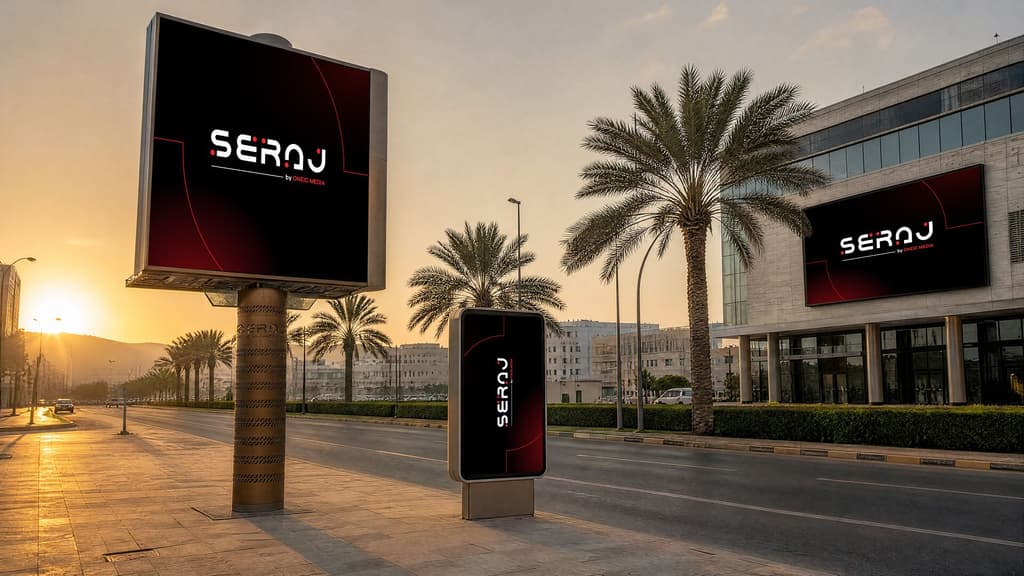
The message stays in place, so the audience sees it again and again. That repetition helps a brand feel familiar, and familiarity often matters more than complexity. Seraj Media has a network of 350+ static and digital screens across Oman.
This format is a strong fit for launches, brand reminders, and long-running campaigns. It does not depend on motion or changing creativity. Instead, it relies on placement and frequency. That makes it a practical choice for brands that want calm, consistent visibility rather than fast-changing messaging.
Seraj also uses exclusive contracts across six key regional governorates, which strengthens the value of fixed placements because the same locations can keep delivering reach over time.
Digital Screens: Best for Flexibility and Timely Messaging
Digital out-of-home is the most adaptable format in modern outdoor media. It allows brands to change creative, time messages, and react to campaign needs with more speed than static placements.
That is one reason digital formats continue to drive industry growth. OAAA reported that DOOH was a key growth engine in 2025, rising 10.5% year over year. It also noted that digital billboards were among the most commonly deployed formats in commerce-driven OOH planning.
Digital screens make the most sense when a campaign has several messages, shorter offers, or time-sensitive promotions. They are also useful when a brand wants to stay visually fresh without changing its entire media plan.
Megascreens: Ideal for High-Impact Brand Presence
Megascreens are built for scale. They suit brands that want premium visibility and a strong sense of presence in large public spaces. They are especially useful for major launches, national campaigns, or messages that need to be noticed quickly from a distance.
This format works best when the creative is simple, and the brand wants authority. Big placements reward clear design, short copy, and strong brand marks. They are not meant to explain everything. They are meant to create a moment of recognition.
In a crowded media environment, that kind of presence can be valuable because it signals confidence without needing to say too much.
How to Choose the Right Format for Your Campaign Goal
Choosing the right format starts with a clear understanding of what your campaign needs to achieve. Outdoor advertising is not one-size-fits-all. Each format serves a different purpose, and the strongest campaigns are built by aligning the format with the goal, the audience, and how people move through a space.
- For broad awareness: use large static billboards or digital screens to maximize reach and repeated exposure
- For flexibility and timely messaging: use digital screens that allow you to update content quickly and adapt to campaign changes
- For premium visual impact: large-scale formats like megascreens create a strong, high-end brand presence
- For local frequency: street furniture keeps your message close to daily routines, increasing repeated views
Seraj Media emphasizes a personalized approach, flexible and competitive terms, and creative variety.
This is where strategy matters more than volume. A larger screen is not automatically the better choice. A better choice is the one that matches audience behavior, travel patterns, and message length.
Why OOH Still Holds Its Place in the Media Mix
Outdoor media stays relevant because it reaches people during movement. It does not wait for attention. It meets attention where it already is. That makes it useful in a media world where audiences move between screens, places, and routines all day long.
OAAA’s latest research shows that marketers still see OOH as a core part of connected commerce, while industry revenue growth shows that advertisers continue to invest in the medium at scale.
It also helps that outdoor advertising can support other channels instead of competing with them. A person may see a screen on the road, remember the brand later, and respond online or in-store.
That is why OOH is often strongest when it is part of a wider plan. It adds physical presence to a media mix that is often too digital, too fast, and too easy to overlook.
Conclusion
The smartest way to use outdoor media is to match the format to the goal. Static placements work well for steady visibility. Digital screens work well for flexibility and timing. Megascreens work well for bold presence.
When those choices are made with care, outdoor advertising becomes more than a channel. It becomes a way to place a brand with purpose, in the right environment, at the right scale.
Seraj Media is built around that idea in Oman, with 350+ static and digital screens, 15+ megascreens, 7,000+ total advertising coverage, exclusive contracts across seven regional governorates, and a network designed to create visibility, reach, and impact.