
The Complete Guide to Billboard Sizes and Outdoor Advertising Formats
Intro
Outdoor advertising is still one of the more effective ways to build brand awareness and actually reach people as they go about their day. Someone driving down a highway, walking through a shopping district, waiting for a bus — outdoor ads catch people right where they naturally already are.
But a campaign that actually works takes more than a good-looking design. The billboard size and format you pick can genuinely shape how well your message actually lands and sticks.
With this many options floating around, it's easy to get stuck deciding what's actually right for your business. This guide walks through billboard sizes, the more common outdoor formats, and a few tips for picking what actually fits your campaign.
What Are Billboard Sizes and Why Do They Matter?
Billboard sizes are just the physical dimensions of an outdoor display. Exact measurements shift depending on location and installation, but generally you're looking at anything from smaller local displays up to the massive roadside structures built for maximum visibility.
Size actually affects a handful of things:
- Visibility — bigger billboards can be spotted from farther away, which matters a lot on high-speed roads
- Viewing distance — the farther people are from it, the larger the text and imagery need to be to actually register
- Creative design — bigger boards give you room for bold visuals; smaller ones need a tighter, simpler layout
- Campaign objectives — different goals call for different sizes depending on audience and where it's placed
Worth remembering: bigger isn't automatically better. The right billboard size is whichever one actually fits your goals, your audience, and where it's going up.
Common Billboard Sizes
Outdoor advertising comes in a handful of sizes, each suited to different locations and goals.
Large Roadside Billboards
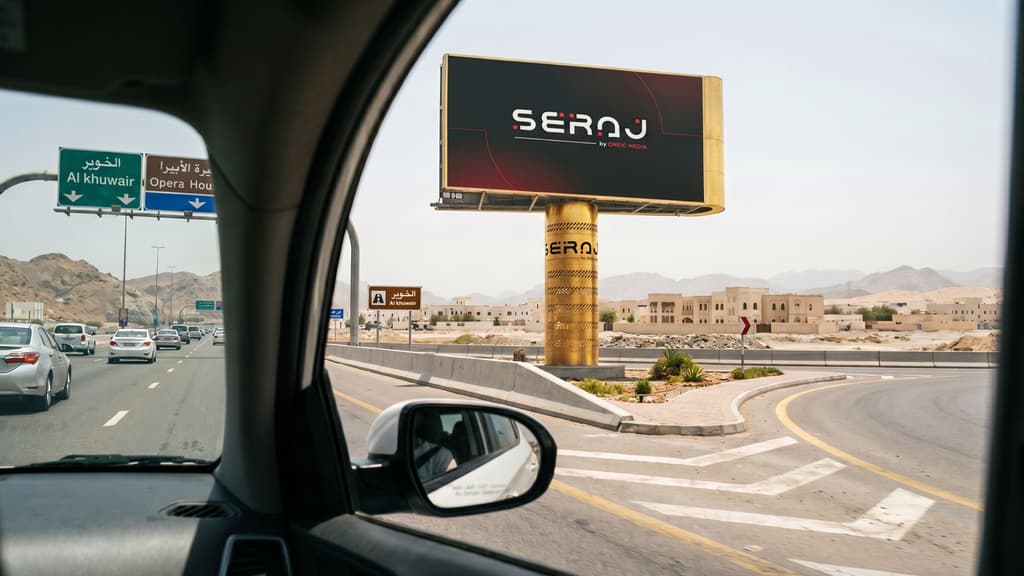
These go up along highways, major roads, and city entrances, where thousands of drivers pass every day.
They work well for:
- Brand awareness campaigns
- National or regional advertising
- Product launches
- Corporate branding
Since cars are usually moving fast, the creative here needs to be bold, the headline short, and the text kept to a minimum — nobody's reading a paragraph at 100 km/h.
Medium Billboards
These usually sit along urban roads and commercial districts where traffic's moving slower.
They strike a balance between reach and local targeting, which makes them a good fit for:
- Retail promotions
- Restaurant advertising
- Local services
- Community events
You can pack in a little more detail here than on a large roadside display, while the message still stays readable.
Small Billboards
You'll spot these in neighborhoods, shopping areas, and local business districts.
They tend to work well for:
- Local businesses
- Directional advertising
- Store promotions
- Event announcements
Since viewers are usually closer up, there's a bit more room to include information — just keep the core message clear.
Rather than obsessing over exact dimensions, it's really about where the ad will sit and how people will actually be viewing it.
Popular Outdoor Advertising Formats
Billboards are just one piece of the outdoor advertising picture. Businesses today have a handful of formats to pick from.
- Traditional billboards carry printed ads that stay up for an extended stretch of time. They give you steady, continuous visibility, which makes them a solid choice for long-term brand-building.
- Digital billboards run on electronic displays you can update remotely. They let you rotate between multiple ads, schedule content throughout the day, launch new promotions fast, and show dynamic material — a genuinely strong pick for anything time-sensitive.
- MUPIs are the street-furniture displays you see in busy pedestrian areas — shopping districts, sidewalks, bus stops. Since people view them up close, they're well-suited to retail promotions, event advertising, and local campaigns.
- LED advertising screens show bright, high-resolution digital content in high-traffic spots. They handle images, animation, and video, pulling attention while letting a campaign get updated quickly whenever needed.
- Transit advertising lives on buses, taxis, and at hubs like metro stations and bus terminals. This puts your message in front of commuters throughout the day, and it stretches your visibility across a lot of different physical locations.
- Building wraps turn the entire exterior of a building into ad space. These tend to show up for major product launches, corporate branding pushes, and big public campaigns in busy urban centers.
How to Choose the Right Billboard Size
Getting this right starts with actually knowing what your campaign's trying to do. Some of the bigger factors to weigh:
- Campaign objectives — building awareness? Promoting an event? Driving people to a nearby store?
- Viewing distance — bigger works better for long-distance viewing; smaller fits when your audience is closer
- Traffic speed — drivers need something simple and bold; pedestrians have more time to actually take in detail
- Target audience — commuters, shoppers, tourists, local residents — think about who you're actually after
- Location — what's around the billboard shapes how well it's actually seen
- Budget — pick something that balances cost against how effective it'll actually be
- Campaign duration — long-term branding tends to suit bigger roadside placements; shorter pushes can do fine in more targeted local spots
The best billboard isn't necessarily the biggest one out there — it's the one reaching the right people, in the right place, at the right time.
Choosing the Right Outdoor Advertising Format
Different formats suit different goals. What's right for you really depends on what you're trying to achieve and who you're trying to reach.
- Brand awareness — large billboards and LED screens work well for reaching a wide audience and building recognition
- Product launches — digital billboards and LED screens let you keep content current as the launch evolves
- Retail promotions — MUPIs and LED screens are strong for pulling shoppers into busy commercial areas
- Event promotion — MUPIs and transit advertising boost visibility among pedestrians and commuters, good for concerts, exhibitions, local events
- Local business marketing — medium and small billboards make sense for promoting within a specific neighborhood or community
- Citywide campaigns — combining a few formats, billboards plus MUPIs plus LED screens plus transit, maximizes reach and reinforces the message across different spots
A lot of the most effective campaigns actually blend formats. A large billboard might build awareness citywide, while MUPIs or LED screens near shopping centers reinforce the message right where customers are about to make a decision.
Design Tips for Different Billboard Sizes
Even a perfect location won't help if the creative on it isn't doing its job. A few things worth keeping in mind:
- Keep the message short — one clear idea people can grasp in a couple of seconds
- Adjust text size for viewing distance — bigger text for roadside billboards, headlines that stay readable from far off
- Lean on bold visuals — sharp images and strong colors are what actually get noticed
- Avoid clutter — too much crammed in makes an ad harder to read, not more informative
- Keep branding consistent — logo, colors, visual identity should be instantly recognizable
- Include a simple call to action — visit the site, scan the code, come into the store
- Design specifically for the format — something built for a billboard usually needs tweaking before it works on a MUPI or digital screen
Simple, memorable design tends to outperform something overly busy, almost every time.
Common Mistakes to Avoid
A few things trip up campaigns more often than they should:
- Picking a billboard size without really thinking about the location
- Cramming in more text than anyone can actually read in time
- Ignoring viewing distance and how fast traffic's moving
- Choosing the wrong format for the audience you're actually after
- Focusing purely on cost instead of overall effectiveness
- Reusing the exact same creative across every format without adjusting it
Taking the time to plan properly up front tends to pay off in a much better return.
Why Professional Media Planning Matters
Good outdoor campaigns rarely happen by accident.
Solid media planning helps businesses land on the right sizes, formats, and locations for whatever they're actually trying to achieve. A more strategic approach helps you:
- Match billboard size to campaign goals
- Find locations that actually reach your target audience
- Get more out of your ad budget
- Coordinate several formats at once
- Improve performance through data, not guesswork
Working with people who actually do this for a living helps make sure every piece of the campaign is pulling in the same direction as your broader marketing strategy.
Conclusion
Getting billboard size right matters, but it's really just one part of a bigger picture. The strongest results come from pairing the right format with smart locations, solid creative, and clear goals from the start.
Whether you land on traditional billboards, digital billboards, MUPIs, LED screens, or some mix of all of it, the real key is choosing whatever actually fits your audience and your goals.
If you're ready to make a bigger impact with your outdoor advertising, SERAJ Media can help. Our team pairs strategic media planning with access to premium outdoor locations across Oman to build campaigns that genuinely increase visibility and deliver results you can actually measure.